
On Wednesday, February 9, 2022, I had just finished an accomplishment. One that was apparently very surprising for some and extremely difficult for others. A lot of people celebrate reading this book as if they were at a New Year’s Party, but I didn’t.
Partially because I had to start To Kill A Mockingbird next, and also because of the weight I had to carry around with me at school due to it.
The book you ask? It’s nothing other than the world’s first novel, Genji monogatari. Or to be more easier to all of you guys who don’t know Japanese, The Tale of Genji. It’s a pretty fascinating novel, noting how extremely complex it is (I’m actually trying to convince my friend, Surya, to read it.) and how descriptive the language is. But in order for me to continue, I’ll need to give y’all some background info.
The History
The Tale of Genji was first conceived and written in the Heian period (794-1185), an era where Chinese influence in Japan was at its peak. This was also a time when Japanese Imperial Courts had their shine. Most of the literature, art, and poetry rose to amazing heights. I somehow found out that even two dialects of Japanese were formed then, Katakana and Hiragana.
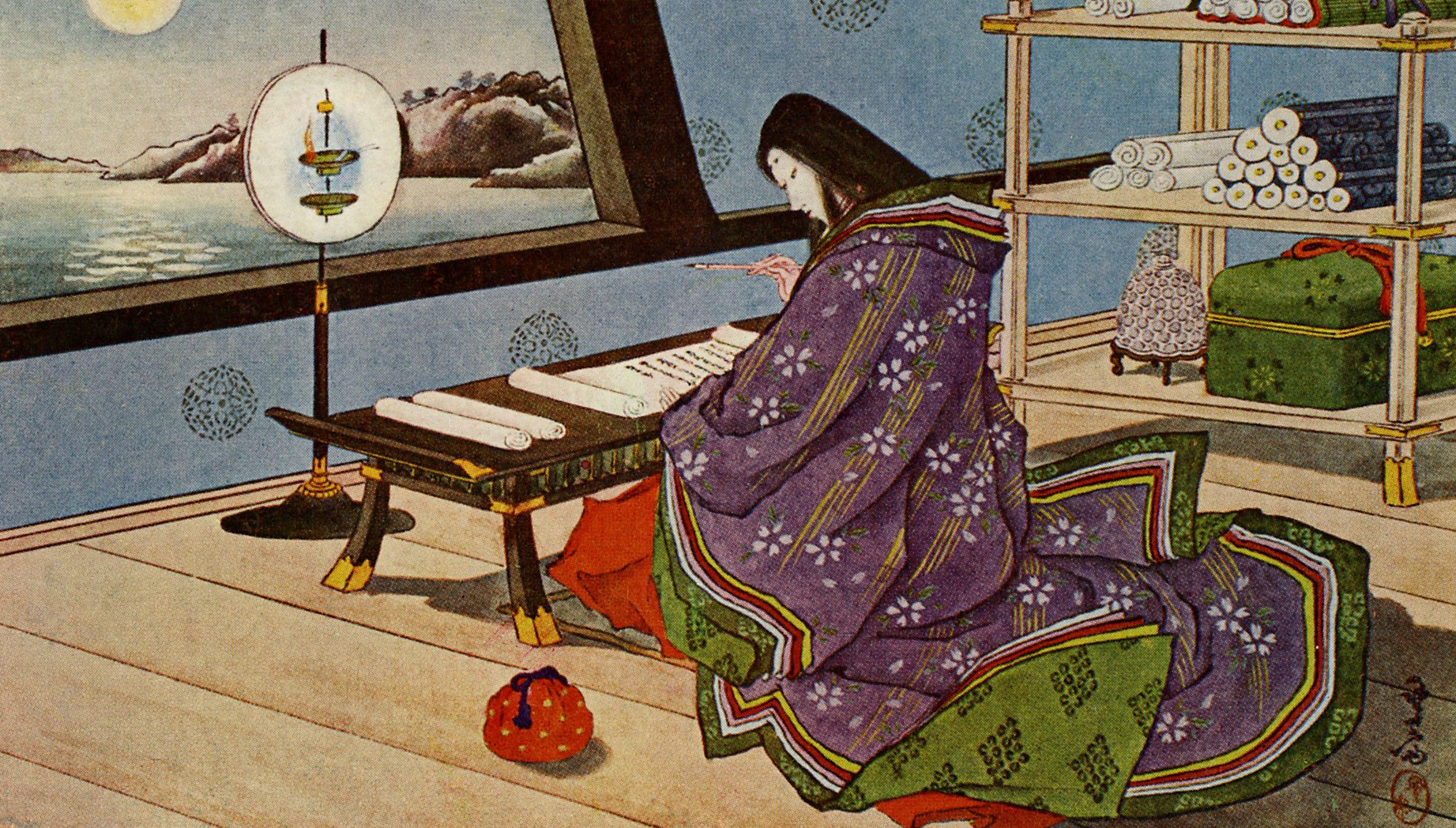
These were the things that revolved around Murasaki Shikibu (This was actually her pen name, as the author was extremely private. In order to make it easier for you and I, I’ll call her by that), a lady-in-waiting for the Imperial Court, which meant that if the judges or royal family needed some entertainment, they could just send her a letter and she’d be right before them with some poetry or prose. Somehow she got the idea to write The Tale of Genji and executed it in Orihon style by taking each paper and pasting it on the sides. Now that you have an idea about the background of the author, let me tell you about the actual book.
The Plot
The storyline revolves around the life of Hikaru Genji, the son of a famous ruler, Emperor Kiritsubo. It takes place from his early twenties to his late seventies, I think. It’s mostly about his romances, which I thought were kind of over abundant and some unnecessary. About a quarter into the story his father apparently takes him out of the line of succession, instead changing his status to that of a below average commoner, whilst changing his surname. After 41 chapters (and one supposedly blank one), the narrative shifts from him to his descendants. One of them is publicly known, the other being Genji’s illegitimate child (Don’t worry, there aren’t any mature scenes in this book.), which kind of spirals out of control.
Some Bio About The Book
The whole novel is 54 chapters, which needs you to be prepared. My advice; have a lot of energy, a high Lexile, and sanity before you attempt to read it. The chapter length varies a lot, for some are about 65 pages long, and others as short as 3 pages.
Yeah, it’s one heck of a book.
Sinceit was completed in 1008, the language is super complicated, so take some valuable time to research a good, nicely rated translation, like Dennis Washburn’s. I also recommend an unabridged one, as you can get more of the original material, otherwise you’re gonna lose hair in frustration faster than one of my family members. Although the whole idea of reading is difficult, you’ll actually start to find it pretty interesting and versatile from any other books.
Why I Personally Found It Interesting
The whole reason why I still persevered to read was not because of the interesting plot, but due to the intricate execution of it. The chapters are always a challenge to keep up with, as they usually revolve around different periods of Genji’s life in a non-linear format. It kind of felt like the Memento of Japanese literature to me, just because of how well planned it was.
I honestly need to give a round of applause to Lady Murasaki because of how well executed and detailed it was. I originally thought the world’s first novel wouldn’t be as complex and as exquisite, but I had no right to say that, for I never read it.
But now I did. And I think you should too.